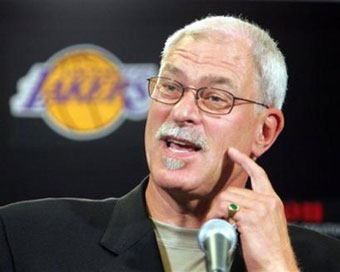
“I’m so outta here. They forget my contract is up soon too…This wasn’t bad for a while, I didn’t have to do much, I made twice the money I would’ve if I’d taken that front office gig and this might give me a legitamate excuse to retire before they try and expose me for not developing talent. Again. These kids don’t listen anyway, which is exactly why I wanted veterans. They’re hungry, they just need direction, not a damn babysitter. I tried to give Kwame ‘The Joy of Cooking’, something, anything to get the boy to use his damn hands and what does he do? Maybe I shouldn’t have called him a pussy, but who the hell throws cakes at people anyway, is this candid camera? Damn, I’m really dating myself there. Wonder what Red would do in this situation…. Why is Kobe the last to know about Buss’ intentions anyway? I told the whole damn world in my book. That kid should’ve gone to college if only to learn when he’s being manipulated…. I can’t blame Kobe again, can I? Or should I just start discrediting Skiles and Isiah? They aren’t championship coaches, I am….Actually, is there any way we can get Gordon and Deng, then Arenas next summer? Gil would eat this Zen shit up…”
“When Magic demanded a trade, I just fired Westhead…Nah…What was I thinking? Why would I let Jim deem Bynum untouchable and let Kupchack pass on every one of the kid’s suggestions? Who did Davis get traded for again? Speedy Claxton? Damn, that made us look dumb. Or deceitful. Like I was just using the kid to sell tix and avoid the luxury tax by developing young players. Is that what I was trying to do? And how would it have worked anyway if I gave him an option and that damn no trade clause? And where the hell is that waitress with my drink? And didn’t I tell whatshername to get me one too? Doesn’t anyone around here speak English? Spain. Never again….Maybe I actually should trade him. What are our chances of improving to his satisfaction before he can opt out in a couple of years and we get nothing? And he has to know that he tied our hands to negotiate with other teams. Who would trade anything to help a team with a disgruntled superstar, when they could manage their cap over the next two years and possibly sign that superstar? He’s the only player we can trade now, might as well move him while his value’s at it’s peak. This is a good draft, Chicago has that lottery pick and P.J. Brown’s expiring contract. And I do like that Zero Hero, I wonder what he’d want….I wonder if any of these girls can drive a stick….”
“..............Is Sonic open 24/7? I could really use one of those smoothies...........I miss Jerry West, he loved smoothies and he was so nice to me..............You know who else probably likes smoothies? That kid Sebastian Telfair....................Yeah, he’d be a good fit here, maybe that’d get Phil to lighten up a bit..................Gosh, he can be a real jerk when he doesn’t get his way, what did I ever do to him?...........I’ve gotta stop thinking so much, I’m gonna burn myself out...............................................What time is it anyway, am I missing ‘John From Cincinnati’?............I’ve got to learn how to work that damn Tivo...........................Man, this is a pretty good show. I wonder if he’ll heal that boy’s spine next week............. I can’t wait, not much else on TV this summer, makes it tough to find good conversation at the office..........Okay, relax, then smoothies, then Telfair..............Zzzzzz...”
“God, these Finals were a disaster. The kid could’ve at least made it interesting…. Kobe getting traded would restore a balance between the two Conferences and stop all this nonsense about realignment or reseeding. What the hell do they think this is, football? That reminds me, I need to fine Gooden for that neck goatee of his. I can do that right? Damn right I can! Plus LeBron, Wade and Kobe in the same conference would settle all this ‘Next Jordan’ talk unequivocally. All of them battling each other four times a year? It’d certainly give Shaq somehting to talk about for a while, I’m worried about him. Yeah, this is starting to sound good. People might not complain as much about Durant and Oden on so late if they had Chicago v. Miami as an appetizer. Actually, maybe Kobe could fix the Knicks? Nah, not until Isiah’s gone, that would be a disaster…. What am I going to do about him? Chicago is probably best, that Jordan story has legs. Long legs. Money too.... Where’s my phone?”
“That call is coming soon. The pieces I’d have to give up to get K.G. would leave us without a dependable scorer and this team still wouldn’t have a definitive leader where we need it. I love Kevin, but once Gordon is gone, would he carry us through our scoring droughts, which are far too frequent? Would he take over the fourth quarter for us? Or would we have lost all of our youth, maxed out our cap and have not gotten any better where we need to? I’m just not sure about him and Ben certainly isn’t gonna put any points on the board either. I give up our lottery pick, Gordon, Deng, P.J.’s contract, and Duhon and we’ve still got enough to compete. I think that would satisfy L.A. too, besides they’re probably already sizing Arenas up as a replacement anyway. Hinrich, Kobe, Nocioni, Tyrus and Wallace could win the Conference next year if we could pick up a decent sixth man with our mid-level exemption. Cleveland showed what a defensive minded team with an explosive scorer can do. If LeBron had a perimeter game, Cleveland had a real shot in that series. Now it’s our turn. I’m glad we made the hard sell to the kid when he was a free agent. He knows we’re committed and that’ll play big in his decision making. He’d want to be here anyway. It’s the only way he’ll ever truly redeem himself, coming in here and overtly challenging Michael’s legacy. I think he can do it too. This is gonna happen, I can’t believe it. Where’s my phone? I gotta thank Isiah...”
He’s never been a sympathetic figure. But many of the things he’s done have been in pursuit of becoming the best basketball player he could be, the best basketball player ever. He feels as though it’s his turn, it’s his destiny.
Kobe Bryant is going to get what he wants. He just doesn’t know where yet. Half-hearted ultimatums and retractions aside, his 48 hour media blitzkrieg effectively granted the Lakers a two year amnesty. Chip or bust. Get down or lay down. Three years after his free agency loomed over the franchise, he’s proven he’s still in control and now everyone knows it. Which is why it’s time to trade him before it’s too late.
Long before him, basketball has been a stars game. One player can’t win titles alone, but he’ll get you damn close and so it’s only prudent to build around that star. Especially if he sells tickets. Therein lies a problem with all professional sports, but primarily in the NBA. The goal of the game is to win, but the goal of a business is to make money and the two agendas often intersect with disastrous results. This has held true for both the players and their respective franchises over the years. But even in a league of free agency with big salaries and big market benefits, to some, there’s still no substitute for winning.
The NBA is tough. Playing basketball 24/7 sounds like a dream to most, but the rigors of constant training, traveling and trades are very real and only truly known by professionals. Which is why it’s easy to see how some of them can grow fat on their success. A deeper hunger is needed from a player who seeks not only to improve or succeed, but to leave an imprint on the game itself. It’s the hunger to dominate. Just as Michael Jordan used Magic and Bird as a constant motivation long past their declines, Kobe has been chasing him. They all know they’re not truly the successor until they’ve out-achieved their predecessors. Everything Kobe’s done has been in pursuit of that lineage. Which is why he feels so betrayed by what is perceived to have been a con by Laker management.
The writing was all over the walls of Staples Center in the summer of ‘04. After a Finals upset by Detroit Kobe’s intrinsic value was still readily apparent, but his public perception was at an all-time low. The rape charges and internal feuding had taken their toll on him and he had begun to feel as though it was time for a change. He knew he’d never be considered a true great while playing in Shaq’s shadow and under Phil’s thumb. Management also knew this and while their rivalry may have weighed on his resigning with the Lakers, according to Kobe, it had very little to do with Shaq’s departure. Despite an impressive Finals performance, Shaq was clearly entering a decline and extending him would only be a burden on the salary cap as he regressed in his later years. So Jerry Buss made it clear to Kobe that regardless of his impending free agency decision, O’Neal was gone.
“He told me he wanted to trade Shaquille. He didn’t want to pay the $30 million or whatever it was. He felt he was getting older and it was time to trade him. He said, `I don’t care what you decide to do. I’m letting you know that I’ve decided to let (O’Neal) go. Now I hear that a Laker insider is saying this. Now I’ve got serious trust issues. They know I had nothing to do with that. Jerry Buss knows it. He called me on the eve of me making my decision, from his vacation in Italy.”-Kobe Bryant, 570AM w/ Petros and Money
But Kobe still had his reservations. Yes, the franchise had accommodated him throughout his trials, but he had always given them his best and the time had come for him to consider his future. Winning was the only answer to his problems and he wasn’t sure he could do that with the Lakers. Again, Buss reassured him.
“That’s the call that really swayed me. If you look at all the teams that have been quote-unquote dynasties, it normally takes about nine or 10 years to rebuild. That was my concern when I spoke with Dr. Buss. I said, `Are you guys on a nine- or 10-year plan? Are you on a long-term plan?’ Or do you want to try to rebuild this team right away and be aggressive. … That was my No. 1 concern, and he promised me that they would do whatever they can to go out and get players. They were going to be extremely aggressive. They are going to rebuild right now. This is not something where they wanted to wait. They wanted to get back to a championship level right now. That swayed my decision. I was leaning toward going to Chicago, and the Clippers as well, just for the fact that it was a new challenge and they have players that I’ve known for a while. … I wanted to play for the Lakers, and Jerry Buss called me from his vacation in Italy and promised that they wanted to rebuild right now. I trusted that promise and went with them.”
Who would deny Jerry Buss if he said he was committed to continuing the tradition of Laker excellence? Who would want to play with a guy who made no secret of his animosity towards their ambition? Not him.
Only now he realizes he’s been used. By everyone.
[on being blamed for the Shaquille O’Neal trade]“I’ve had many media people come up to me and say, `You know the Lakers are having you take the bullet for this one, right?’ I just shrugged it off, because it was about moving forward. Now when I see that a `Laker insider’ says I ran Shaq off, OK, now I’ve got a serious issue with that. I took it in stride the first time, because I assumed it was just talk. Now I find out that it’s coming from Laker insiders. Now I’ve got serious issues. I’m speaking my mind, because I’m not taking the bullet for something I did not say or did not do.”
[on the rebuilding process]“For the past few years, I’ve been meeting with Mitch and Dr. Buss in the offseason, talking to them about players. Most of the players call me, because I know most of them. Baron Davis called me and indicated he wanted to come out here and hoop with us. Same thing with Carlos Boozer. Same thing with Ron Artest. My response to them has been, `You know what? I love it. Let me call you back. I’m going to call Mitch and see what I can do. Let me (call) you back.’ Every time I had to call back and say they didn’t want to do it because of this or that. In Baron’s case it was because he was injury prone. In Carlos Boozer’s case it was because he can’t guard forwards. It was always something. Then they traded my man, Caron Butler, which made me feel terrible because he and I had been working out that whole summer. … Then I get a call, telling me that he’s been traded. They were asking me about my thoughts on that, and I said, `Why are you asking me my thoughts now? You already did the trade?’ Through all of these three years, and the time it’s taking to rebuild, enough is enough. That’s why I’ve been very vocal.”
Kobe felt as though he had some control and so did everyone else. Which is just what they wanted. But in light of recent events, the question has to be asked; if Kobe really did hold that much influence over the organization as to personally have O’Neal and Jackson jettisoned, then why didn’t it extend to acquiring Baron, Boozer, Butler or Artest? The answer appears to be that the Lakers never planned on spending any money. Management knew Kobe would be seen as a tyrant who banished two of the game’s treasures and it suited their agenda perfectly. The longer that he was nationally deemed the cause of the Lakers failures, the longer it allowed them to rescind spending to get back under the salary cap and luxury tax. Which meant not resigning Shaq or trading for players of ‘questionable value’. Local fans could be sustained by Kobe and the promise of a bright future, which was the integral piece to the team and the franchise moving through a transitional period as Buss nears retirement. He’s certain to pass control of the organization down to his children, Jim and Jeanie, whose quarrels on L.A. radio over the teams direction lit the fuse leading to Kobe’s bombshell.
The common thread throughout all of this? Phil Jackson.
Jim’s nurturing of prodigy Andrew Bynum has long been evidence of the Lakers commitment to a youth movement and his comments questioning Phil’s ability to foster it have been a point of contention for weeks within the front offices. Jackson chastised his students all year in the press and Jim wondered aloud whether this was best for a team in it’s developmental stages. Jackson, with his preference for hungry veterans, had always been critical of young players and the consequences of their immaturities. He was quoted as being less than impressed with his roster’s predilection for porn and video games and claimed that Jesus Christ himself couldn’t save them. There was an obvious rift between the coach and upper management.
Of course the coach also lives with upper management. After Jeanie Buss and assistant coach Kurt Rambis sounded off on Jim’s criticism of the Zen Master, it was clear that the power struggle of the Laker front offices had spilled into public view. Enter Ric Bucher, Stephen A. Smith and anyone else with a microphone breathlessly awaiting Kobe’s assessment of the situation. He probably would’ve gone on Imus if it were possible.
His solution? Bring back Jerry West. Not gonna happen. And why did West leave in the first place? Phil Jackson. Who prompted Kobe’s outbursts with tales of management’s long term rebuilding plans? Phil Jackson. Who reasoned with Kobe and averted another Hollywood breakup? Phil Jackson. Who was ultimately responsible for the first breakup? Phil Jackson.
It was Phil who ruffled West’s majestic feathers. It was Phil who was entrusted to end Star Wars, but chose to exacerbate the situation. It was Phil who left Kobe to the heavy lifting after he had dismissed the current roster as dead weight. It was Phil who coerced Kobe into speaking on his behalf when he had no leverage and when that talk pushed Kobe where he couldn’t follow, it was Phil who reigned him back in. It’s Phil who is looking for another title and another multi-year, multi-million extension. Phil Jackson has long been derided as a coach who manages talent rather than nourishing it and if Kobe were to leave Los Angeles, Jackson would be exposed for attack. He was the one who was brought back to placate Kobe and once again, he is the one mainpulating Kobe. He deserves as much as much of the blame for this as Jerry Buss. It's Phil Jackson who is selfish and avoiding his comeuppance.
Kobe’s rumored destination? Chicago, hungry for past glory after a controversial rebuilding process and the tumultuous departure of, um, Phil Jackson.
But no matter what he whispers in Kobe's ear, Phil Jackson can’t save the Lakers. Not soon enough. And as Kobe continues to age at a rate belied by his years, today will haunt the franchise until he puts pen to another contract. He now feels as though he’s been slighted by the entire organization and isn’t likely to forget it. How long can the Lakers delay the inevitable? With a trade veto and the clock ticking, Kobe Bryant is going to get what he wants, he just doesn’t know when yet.
The last time the Portland Trailblazers passed on a college phenom because the respective position was filled, they missed out on Michael Jordan.
Lets hope it doesn’t happen again.
The Blazers are already stocked with post players and they could use talent at the swingman. But if GM Kevin Pritchard knows what’s good for him, he’ll take the phone off the hook and ignore any trade offers or advice to draft Kevin Durant. No, Durant isn’t Sam Bowie, but Greg Oden is the only answer. Even if the team is swollen at that spot, draft the best player and work it out afterwards. It’s better to have him and be able to make a trade later than to regret not having drafted him at all. Does anyone think that Oden’s value is going anywhere but up? So pick him and experiment.
No matter how much the game may open up in the next decade, Oden has the athleticism and skill set to keep up and is certainly equipped to dominate the half court game. He has the wingspan and mobility of a condor and pairing him with another seven foot wunderkind in LaMarcus Aldridge gives Portland a frontcourt that could feast on the Western Conference well into the future. Zach Randolph has elevated his game to All-Star status, which is why there’s no better time to trade him. No matter how far he’s come, he’s still the expendable player in this situation. Just as Ricky Davis was jettisoned far from an impressionable LeBron James, Z-Bo and Darius Miles should be shopped to officially end the Jailblazers era. Headcases that they are, they’d still fetch some spare parts and a quality point guard to complete the backcourt alongside Brandon R.O.Y. Jason Kidd? Mike Bibby? Jason Terry? Mike Conley? This could be a playoff team next year. Best believe Bill Walton broke out the special stash tonight.
And it was all shitty just a week ago. The Sonics had no GM or a head coach and looked as though their next playoff appearance wasn’t even going to be in Seattle. Owner Clay Bennett wasn’t getting the legislative support he needed for a new stadium and was involved in an increasingly bitter relationship with the media. Assuming that everyone will be more inclined to work things out now, the team should have their pick of coaching and managment talent to steer them deep into the playoffs. If they choose to re-sign Rashard Lewis, with Durant and Ray Allen the Sonics would have the personnel to rip and run with the best of ‘em.
Who didn’t fax their resume into Seattle front offices tonight?
But who knows what will happen in the upcoming weeks? Except that which was already promised to be an eventful offseason just got all the more interesting. We’re heading into a summer with Chauncey Billups, Vince Carter and Jermaine O’Neal on the market and Shawn Marion, Jason Kidd, Pau Gasol and Kevin Garnett (allegedly) on the trading block.
Specualte to your heart’s content, just know that Durant and Oden will both end up with the swoosh. Some things are just meant to be.
val·u·a·ble [val-yoo-uh-buhl]–adjective 1. having considerable monetary worth; costing or bringing a high price: a valuable painting; a valuable crop. 2. having qualities worthy of respect, admiration, or esteem: a valuable friend. 3. of considerable use, service, or importance: a valuable player. 4. apparently not Jerry West. (But he got the logo, so it's all good.)
NBA greats are a unique breed in the sporting pantheon. No athlete can impose pure will on his respective sport like a basketball player. There’s no disconnect between offense and defense, which gives a player more influence over his teammates on both sides of the ball. They’re the only athletes who can make a play for the crucial score and inasplitsecond make a stop that seals the win. In fact, most times they are expected to. Basketball players carry a heavier burden than their contemporaries. This is what makes the NBA’s Most Valuable Player so special. A Podoloff Trophy is the mark of greatness.
How is greatness measured? By the media. Every year, 125 pen, pad and agenda carrying sportswriters and broadcasters-with legends to build and stories to sell-decide upon whom to bestow the game’s crowning individual achievement. Truth is, if you locked those guys in a room a until they could decide upon a criterion for the award, they’d die in there. The MVP is a popularity contest, an award for modern marvels and sentimental favorites. Analysis of voting totals over the past twenty plus years reveal neither rhyme nor reason. There are numerous instances of both personal and team improvement having been in vain, while post and perimeter players are alternately fawned over and ignored. Players in contention are expected to take their teams to the postseason, yet postseason play doesn’t factor in the award? Practically every year reflects a different rhetoric.
So what is the formula? Carpe diem. Since 1984 there have been a dozen different Podoloff winners. Three men laced ‘em up and forged their own destines. Others labored to receive their due recognition. There were a couple guys you couldn’t help but love, and a few just got fucked over. Using the playoffs as a litmus test, let’s reminisce...
Before him, when a player was trapped in the post by an aggressive double team, he either passed the ball into a corner, called a timeout, or forced a shot. He didn’t throw it blindly over his head and through the outstretched arms of the defense directly to a teammate under the basket for an easy bucket. Before Earvin Johnson the game had flair, but no Magic.
His lengthy 6′9″ frame inhaled rebounds, his vision and dexterity maneuvered the court in bullet time, and his immaculate touch blessed those passes which always found a teammates hands in the shooting position. But it was his smile that explained it all. It was that smile that said, “I didn’t go behind my back for a lookaway pass to show off, I did it cause the defender in front of the hoop was trying to deny me the left, and it was the best way for me to hit my streaking teammate on the right without the D being the wiser.”
Before him, when a 6′10″ forward attacked the baseline only to be met midair by the extended arms of the opposing center, he either got blocked or traveled. He didn’t toss the ball overhead off the backboard, box out the center during his landing, catch the pass-to himself-and finish off the play with an easy lay in. Larry Bird was pretty good his damn self.
His size made him a post presence and he only needed the smallest window of space to get his shot off thanks to those thick, strong, wrists but other than that, he played a game of athleticism with no physical gifts. Regardless, he dominated with an ease and confidence of men with twice his ability. Actually, calling it confidence is an understatement. “In your fuckingface” might have been his middle name. Bird’s perpetual swagger was that of a man who had immersed himself in the game, a man who had seen and done it all. So whether he was tiptoeing the baseline-behind the backboard-or was trapped in a corner behind a double team, when he shot it over them, he knew it was going in. And he’d let you know too, before, and after it happened.
Their impact was immediate and widespread. They not only improved their respective teams, together they changed the game and saved the league.
It was almost cruel to choose between them, but from the beginning, to the powers that be Bird was the word. French Lick’s finest had bested Buck to capture Rookie of the Year in 1980, and finished fourth in that years MVP balloting. The winner? Magic’s supposed benefactor, Kareem Abdul-Jabbar, whose scoring went up a point (23.8 to 24.8), but averaged two less boards and one less assist per game than the previous year (12.8 & 5.4 to 10.8 & 4.5). After replacing his injured center in an unforgettable Game6, Johnson won his first Finals MVP, but wouldn’t crack the top five on the regular season ballot until 1983.
He was sidelined by an injured knee in ‘81 resulting in only 37 games, and was besmirched by scandal in ‘82 after demanding a trade. Instead, Jerry Buss fired coach Paul Westhead, who favored a more conservative offense over Magic’s freewheeling play, and entrusted another visionary in Pat Riley. The Lakers regrouped and won 57 games in(50-21 w/ Riley) ‘82, best in the West, but the damage to Magic’s image had been done. He missed a triple double average by fractions (18.6, 9.6, 9.5), jacked a lig leading 2.7 steals, and it didn’t matter at all. The man finished eighth. He’d have to settle for another chip, and another Finals MVP.
Since the addition of Robert Parish & Kevin McHale in ‘81 (Championship year), Larry Bird was the MVP runner-up for threestraightyears. He claimed his first Podoloff in ‘84 and promptly propelled the Celtics into the Finals for the second time. Magic Johnson had three Finals appearances, two rings and two Finals MVP awards when he collided with his nemesis in the 1984 NBA Finals, but Bird was still seen as the better-and more valuable-player.
1984 NBA Finals, Game 7, Lakers @ Celtics
Magic didn’t do enough to change that perception.
1984-85-The Celtics (63-19) and Lakers (62-20) marched through the regular season towards the inevitable Finals rematch. Haunted by the mistakes of last year’s Finals, Magic answered critics questions about his leadership with a healthier season of increased scoring(18.3,6.2,12.6) as the Lakers took the West for the fourth straight year. Bird responded with career highs in points and assists, (28.7,10.5,6.6) including a 60 point masterpiece-only the 10th player in league history to do so.
Terry Cummings (23.6,9.1,2.9), Moses Malone (24.6,13.1,1.6), and Alex English (27.9,5.7,4.2) led the Bucks (59-23,+9 games), Sixers (58-24,+6 games) and Nuggets (52-30,+14 games) respectively as the league’s only other 50+ win teams. What could have been a close race turned out to be a landslide for Bird.
Four of the league’s top five clubs had teammates that received votes. Even the 24-58 Knicks squeezed two guys in. How is Bird the only Celtic? McHale (19.9,9.0,1.8) and Parish (17.6,10.6,1.6) were hardly slacking.
Why wasn’t Magic similarly recognized as the de facto leader of the Lakers? Was it Bird’s scoring?
English & Natt combined to make the Nuggets the league’s most improved team and won their division. Where’s the love? Especially when there’s two Bucks in the top ten?
Bird probably should have won, but by so much? Magic gets only one first place vote? Even the rookie got two!
What happened when the immovable object met the irresistible force? Magic Johnson earned the first Honorary T.R.O.Y. Retroactive M.V.P. 1985 NBA Finals, Game 6, Lakers @ Celtics
Kareem Abdul-Jabbar may have been the MVP of this series, but he was also 37 years old at the time. His performance was certainly worthy, but primarily ceremonial. He became the playoffs all time leading scorer during the series and the cognoscenti were feeling nostalgic. The man was past his prime and everyone knew it. Magic was the driving force behind that team, he was Showtime. He was the one who had improved his already exceptional game, resulting in an eight game improvement in the win column. He was the one with demons to face. Who would’ve shouldered the blame if the Lakers lost again? So let him reap the benefits. The Memorial Day Massacre should have crippled their confidence. Instead they became the first-and only-visiting team to celebrate a chip in Boston Garden. Kareem was a workhorse, no doubt, but Magic (15 APG in the Finals!) was the glue that held the team together.
1985-86-Not much of a contest. Widely considered to be one of history’s ten best teams, the Celtics went 67-15 and after some minor hiccups…
1986 Eastern Conference Playoffs First Round, Game 1, Bulls @ Celtics
1986 Eastern Conference Playoffs First Round, Game 2, Bulls @ Celtics
…they cruised to their second title in three years.
Bird’s third consecutive MVP was legit, but there’s still a few lingering questions.
Showtime went 62-20 and Magic comes in third? Not one first place vote?
Dominique Wilkins (30.3, 7.9, 2.6) carried the Hawks to 50 wins and finished in front of Johnson wiht five first place votes. Granted, there was a sixteen game progression, but still a dozen wins less than Los Angele, a perennial contender. Are the voters saying ‘Nique did more with less?
Again, why were Magic (18.8,5.9,12.6) and Cap (23.4,6.1,3.5) sharing votes when Bird (25.8,9.8,6.8) and McHale (21.3,8.1,2.7) weren’t? Because Cap was a legend and McHale was in his fourth year? They were both All Stars that year. Because Cap finished the plays and Magic only passed it to him? Despite all of his brilliance, Magic was a guard. Guards didn’t win MVP. Right?
1986-87-The takeover. This season was the first time in the history of the MVP award that the winner and the runner-up were both guards. It just didn’t happen. Since the game’s inception, big men-particularly centers-were deemed higher in the game’s pecking order than their counterparts. The big man’s ability to score from the interior with a high field goal percentage, in addition to an imposing defensive presence and steady rebounding was crucial to team success. Their overall impact on a game was greater than that of smaller players dependent on their jumpshots and ill equipped to battle in the paint. The name of the game was to put the ball in the basket, and the man at the basket controlled the game. From Russell to Moses, post players won championships, so they were inherently more valuable. Right?
The efficiency of the game was with the big men, but they had their limitations. They couldn’t handle the ball as well and their decision making in the open court was generally suspect. They were considerably slower than guards and more predictable due to their limited range and movement. Post players were chained to the basket and needed the ball fed to them.
The soul, the creativity, the artistry, the future of the game was with the guard.
Magic Johnson (23.9,6.3,12.2) had a statistical buffet, gorging on the competition in 65 Laker victories. Onlythefourth guard to win the Podoloff in it’s 31 years, he certified his value in another iconic postseason.
1987 NBA Finals, Game 4, Lakers @ Celtics
Then there was Michael Jordan (37.1,5.2,4.6). A streaking explosion of coiled muscles. A barrage of pivots, pump fakes, reverse pivots, jab steps, pull ups and fallaways. A cavalcade of double clutches, up and unders, baby hooks, runners, reverses, teardrops and bankshots. Then there were the dunks. It was endless.
February 26, Nets @ Bulls
March 4, Bulls @ Pistons
March 24, 76ers @ Bulls
He only stopped because the schedule did. Jordan had torched the NBA for it’s first 3,000 point season in 24 years-from the two spot. Finishing second, he would have joined Kareem AbdulJabbar and BobPetit as the only players from losing teams (40-42) declared MVP. That year’s ballot indicated a changing of the guard.
Dominique Wilkins (29.0) was the L’s second leading scorer and the Hawks (57-25) conquered a Central Division with two other 50+win teams and the Bulls. Atlanta had the third best record in the league and the next highest scorer on that team was Kevin Willis (16.1). He was supported by Doc Rivers (12.8), Randy Wittman (12.7) and Mike McGee (10.4). He took less shots (24.3 to 22.6), had less turnovers (3.2 to 2.7) and more assists (2.6 to 3.3) Drowned out by cheers for Jordan, he didnt get one first place vote, and even Kevin McHale finished with twice as many points as him (254/128). So was Nique rewarded for lifting his team the previous year, or just reaping the benefits of Jordan’s absence?
Speaking of McHale, he did improve that year, but shouldn’t that be a testament to Bird’s influence as it was in the past? He only had three points last year, having played only nine less games. Did this mean the voters suddenly couldn’t tell who was responsible for the Celtics success?
Bird (28.1, +2.3 on ‘86) was the Lig’s fourth leading scorer, and averaged a career high in assists (7.6). The Celtics (59-23) held down the Atlantic-and the East-again. How does anyone from a sub.500 team finish with twice as many points and a ten to one first place vote ratio? Isn’t this the reigning three time MVP?
Isiah Thomas (20.6,3.9 & 10.0)? 52 wins? Anyone? Only 17 total points? Anyone? Anyone?
“It would have been tough, if not impossible to keep scoring like I did during the 86-87 season. I attacked from he opening tip until the last whistle for 82 games. That was my mentality. In terms of physical talent we probably has less on that team than any other Bulls team I played on. I knew I needed to score if we were going to be successful. I’m pretty sure Doug Collins felt the same way. I had one streak of nine straight games with 40 or more points. You have no idea how much energy it takes to score 40 points one night. The difference between averaging 32 PPG over an entire season versus a little over 37 is significant. Think of it this way: If I scored 32 one night then I had to score 42 the next night to get even. But that was a different era. Very few teams were as sophisticated defensively as they are today. And no team, with the exception of Detroit the next season, geared its entire defensive gameplan to shutting down one player…
In the early years I compared myself to Magic and Larry. What could I do to elevate my game past theirs?”
1987-88-The blueprint. He already left defenders helpless. But it was his defense that terrorized opponents for the breadth of the court. He was a one man press. His strength, quickness, leaping, anticipation and recognition made him a more intimidating defender than men twice his size. He filled passing lanes, blocked shots from the weakside, stripped penetrating dribbles, skied for rebounds and started countless fastbreaks-which he emphatically finished.
Michael Jordan recorded more than 200 steals and 100 blocks for the second year in a row, a feat never acheived by any other guard even once (236 & 125 in ‘87 to 259 & 131 in ‘88. ). This garnished him the 1988 Defensive Player of the Year Award. Silencing critics who claimed that he was a one man show, Money made a concerted effort to involve his teammates which resulted in a scoring dip (37.1 on 27.8 SPG to 35.0 on 24.4SPG), but also an increase in assists (4.6 to 5.9) and shooting % (48.2 to 53.5). Aside from a paltry 3P % (13.2), his game was utterly flawless.
The Bulls (Seriously, look at that roster. Now.) somehow went 50-32 only to be matched up against a talented Cleveland squad, far better than their 42-40 record after the addition of veteran Larry Nance in a midseason trade. Outmatched and unfazed, Jordan opened the playoffs with consecutive 50 point games against the Cavs, another first in NBA history.
1988 Eastern Conference First Round, Game 1, Cavs @ Bulls
1988 Eastern Conference First Round, Game 2, Cavs @ Bulls
He would goon to average a record 45.2 PPG in the five games and win his first playoff series before falling to the Pistons (4-1) in the next round.
His performance in ‘88 was valuable not only to Chicago, but to the entire league. It was transcendent.
“…They were great all-around players, but they were never known as great defenders. I realized defense could be my way of seperating myself from them. I decided I wanted to be recognized as a player who could inflence the game at either end of the floor. The one thing people saw in me that they didn’t see in Magic or Larry was the athletic ability. They had great talent, but in terms of raw athletic ability I think I had a little more. To some extent I think it was hard for people to believe anyone eho jumped and dunked could also be a complete player. But that’s what I did at North Carolina and that’s what I was trying to do in the NBA. After the 1987-88 season the critics had to say, ‘This kid can have an influence at both ends of the court. He’s not just a scorer.’ Now when they talked about Magic and Larry they also had to talk about defense. I felt like I made the seperation, at least individually, to some extent that season. But I knew I’d never completely be recognized as their equal until we won championships.”-For the Love Of the Game, by Michael Jordan
Kevin McHale played in 13 less games, and saw a decrease in his averages (26.1, 9.9 & 2.6 to 22.6, 8.4 & 2.7) . Bird took two more shots a game that year, and all of McHales MVP votes?
Once again, Dominique Wilkins (30.7, 6.4 & 2.9) is a complete afterthought. Sixth place, huh?
1988-89- The Lakers had become the lig’s first back to back champions in twenty years and despite the reduced minutes and production of Cap’s farewell tour (10.1, 4.5 & 1.0 in 22.9 MPG), Magic considered that year’s team to be the deepest and most talented of his career. Assuming more of a scoring role in the offense, he also increased his assists and rebounds (22.5, 7.9 & 12.8), leading Los Angeles on a collision course with friend and rival, Isiah Thomas.
Magic Johnson broke the mold of the traditional point guard with a size and versatility that impacted the game more than his smaller contemporaries, but Isiah Thomas more than matched his adversary in skill and will. Zeke valiantly fought off a severely sprained ankle with a historic 25 points in the third quarter of the previous years Game 6, bringing Detroit within arms length of a championship, only to succumb to Showtime in seven games. The memory of such a narrow defeat drove Thomas and the Bad Boys to a franchise best 63-19 record in ‘89, securing the all important home court advantage for their Finals rematch.
In an anticlimactic twist of fate, both Magic and Byron Scott would injure their hamstrings, clearing the way for a Pistons sweep. Though Johnson had captured the season’s MVP, the vindication of a title helped Thomas forget that he only received one vote and one point on that years ballot.
But Michael Jordan (32.5, 8.0, 8.0 & 2.9) was more valuable than both of them.
Jordan spent a significant portion of the season at the point dominating smaller guards and during a three week span (3/28-4/14) recorded a triple double in ten of eleven games. However trading away their rebounding enforcer in Charles Oakley caused the Bulls to take a step backwards as a team during the ‘89 regular season. Chicago struggled to stay competitve while incorporating the awkward low post game of Bill Cartwright and developing second year talents Scottie Pippen and Horace Grant. Their modest record of 47-35 was buried in the Central Division and as they stumbled into the playoffs losing eight of ten, playoff expectations were nil.
The Cavaliers (57-25) had taken all five games of the season series and were hungry for playoff revenge. Jordan opened a can of whoop-ass instead, stuffing Cleveland with 39.8, 5.8 & 8.2 before putting them to bed with “The Shot”.
The Bulls won their semi-final matchup with New York (52-30) and handed the Pistons what would ultimately be their only two losses of the postseason in a suprsingly tight six game series.
If the objective of the game is to win a championship, then shouldn’t the most valuable player be the one who gives his respective team the best chance to win? Magic and Zeke steered their talented squads towards June, while Jordan maximized the potential of a team that shouldn’t have lasted past April. An elite player on a mediocre team is needed more, expected to do more, and the fact that the opposition knows this only increases the burden. Off nights aren’t allowed. There is a distinct difference between leading a team and being the team.
With that, I present Money with the second Honorary T.R.O.Y. Retroactive M.V.P.
He's immortal now. Omnipresent. A source of inspiration for faithful legions, a daunting thought for non-believers. He haunts all who dare take the path to greatness, his face flashing before their eyes, his name ringing in their ears. Michael Jeffrey Jordan may still draw breath among the rest of us in this mortal coil, but Michael "Air" Jordan ascended to the height of basketball deity long ago.
There will never be another. I hope.
The distinctive legacy of Michael Jordan is reflective of much more than late night workouts and last second heroics. It is built upon satellites, sneakers and sports drinks. Upon savvy marketing. Jordan used his rocketing stardom and a sprouting media to cultivate and manipulate an image that made him more than an icon. He became a brand of his own.
Playing for Keeps: Michael Jordan and the World He Made, by David Halberstam--First and foremost, David Stern was determined to turn around the league's image. Stern believed that the league's financial and psychological stability depended upon its corporate connections. he saw and envied the tight, almost symbiotic connection between the National Football League and corporate America, so skillfully engineered by Pete Rozelle. He desperately wanted some of the same corporate endorsements to give his shakier league some badly needed legitimacy. He wanted the best of America's heartland companies as his sponsors, nothing less; he wanted companies such as Coke and McDonald's, signature companies of the postwar nation. If they came aboard, so would everyone else. And so he set out, very early on, to try and bring those companies in.
But when he visited the offices of the nation's great advertising firms, the gatekeepers to the great name-brand companies whose sponsorships he coveted, he found a stone wall of resistance, though many were enthusiastic sponsors of college basketball. One Madison Avenue agency representing an auto company was particularly blunt about it-the ad man said he had been instructed by the head of the auto company to sponsor college ball because the pro game was too black. The answer came back, yes, we know your surveys, but the head of the company-my boss-thinks you're too black. When Stern tried to show the demographic studies that the league had put together, studies that showed that the audience for the professional game was not that different from the college game and that blessedly the viewers were young, he received the blankest of stares. Perception, Stern realized was everything, and the general perception of blue-chip American companies was that the game was tarnished, too much a reflection not of sports but of something most Americans wanted to know as little as possible about: black America...
...The college game was almost as black, but perceptions were important, and the college game was perceived, perhaps, unconsciously, as still operating within a white hierarchy, under powerful white supervision, a world where no matter who the foot soldiers were, the generals were still white. (That was at least part of the reason why many people in the world of sports did not like John Thompson and his Georgetown team, a sense that the white hierarchy did not include or control his particular team. Not only was Thompson himself black, but despite Thompson's insistence that all his players go to class and graduate, the team projected a sense of nascent black consciousness.)
...Stern, like Welts, was absolutely convinced that the core of the resistance was about race. He believed that if the NBA could show some discipline and limit the worst, or at least the most noticeable, of the current excesses, then people would be able to see the truly compelling parts of the game: the unmatched athletic ability of the players and the fire with which they competed...
...For better or worse, by the eighties America exported not its machine products or its cars but its culture: its fast foods, Cokes and Big Macs; its more relaxed and informal dress codes; its popular music, movies and television shows. And its sports. The ascending new sport in the world, one that was winning ever greater popularity with the young, was not soccer, though that reigned supreme in many parts of the world, but basketball...
...In retrospect, it was inevitable, therefore that the player catapulted forward as the signature commercial representative of this great new athletic-cultural-commercial empire would be an American and a basketball player. The other dominant American sports were eliminated because of the nature of their footwear. There were no international commercial battles to be fought over football cleats or baseball spikes like those waged in the eighties for the right to be the sneaker king of the world. Nike and Converse and Adidas were ar war with each other, and the NBA was the beneficiary. Hamburger and soft drink companies followed...
...As Nike and other companies featured individual players as stars, and as the league and the network became co-conspirators in the promotion of stars, a major new direction, barely understood at the time, was being charted for the league. It was part of a larger new phenomenon taking place in sports, and in society in general, but most nakedly and obviously in basketball. The game and its top people made a fateful choice: They would go with this modern way or their league would perish as a big time sport. Individual players were now being promoted rather than teams. Something that would have been anathema to owners, coaches, and many athletes in the past, the cult of personality, was now, however unconsciously, becoming mandatory as the sport sought to broaden its fan base. Its advocates, owners, and sponsors no longer saw themselves competing against rival teams or even rival sports. Now they were competing in a far larger and more cutthroat arena-against rock stars, movies, and all kinds of other forms of modern entertainment-for a slice of the entertainment dollar...
...So it was that when Michael Jordan came in the league, a vast number of changes were already beginning to take place in terms both of technology and of international economics that would affect his future and of which he was to become a principal beneficiary. David Stern himself later noted that he had barely noticed Jordan's arrival because he was so caught up in the mundane legal and commercial issues that dominated the daily calendar of a commissioner. In fact, what he remembered most about the draft that year was fining Portland for tampering with Akeem Olajuwon. Still, the arrival of Jordan in the very prime of Stern's career was to be one of the great determining factors in the commissioner's singular success. If Stern had sought no just success but a new kind of respectability for his league, then the arrival of Michael Jordan was like the answer to a Dream.
His singular talent made him an immediate draw, but it was his upbringing that laid a foundation for his marketability. Jordan was the child of an upper-middle class family that stressed hard work and education. He was a product of the NCAA's basketball monastery, North Carolina. He avoided any public dialogue on racial matters and was decidedly apolitical, effectually rendering himself appealing to everyone . He learned from youthful mistakes like wearing his Nike warmups and gold chains in the '85 dunk contest. The veterans saw him as a prideful rookie and Magic allegedly conspired with Isiah to freeze him out of the All-Star game.
SLAM 46, Nov. '00--Common interacted with pro hoop royalty while working as a ball boy for the Bulls from '83-87, just as Jordan entered the League. Common's tale of MJ's first day is a classic: "When he first go to the locker room he was playing 'Friends' by Whodini on this little red radio. They weren't really into him playing rap music in the locker room so they asked him to stop. After a good two exhibition games he could have played 'Fuck The Police' if he wanted to.
But he didn't. Not that he should have, there was money to made. Popularity alone didn't make superstars, Jordan understood the value of a neutral image. His thick Carloina accent, the fur coats, the chains and the music all disappeared, replaced with measured tones and immaculately tailored suits. He maintained a natural ease with the camera and a constant awareness of the public eye. Any chance encounter with Michael Jordan was to be not only a brush with athletic excellence, but a contemporary lesson in style and grace. That is what makes a superstar, talent coupled with the illusion of an unattainable superiority.
What didn't make a superstar in the 80's was hip hop. For a player headlining a league that was striving to escape the onus of being "too black", hip hop was plague. Or was it?
The sneakers were fresh. Functional, groundbreaking technology and luxurious material. Wilford Brimley could have sold them, but the Mars Blackmon ads are among the most popular in television history. A celebrity of Jordan's magnitude promoting products with hip hop was certainly a first, but the actual genius of those commercials was having Jordan play the straight man opposite Mars. It gave them true universal appeal, a nod to the buying power of the 'urban' dollar without Jordan blatantly pandering to that audience, something that would have been embarrassingly inauthentic and counter to his role as the charmer of middle America. In just thirty seconds, he had effectively cornered a demographic while avoiding its stigmas.
Mars Blackmon was a character from Spike Lee's first movie, She's Gotta Have It. Mars was diminutive and obnoxious, coincidentally identical to corporate America's perception of hip hop. The scene was still perceived as a passing fad and was relegated to the fringes of pop culture. These ads were cutting edge for their time and established Jordan as the in vogue pitchman, while boosting the worldwide popularity of hip hop culture.
In the summer of 1989 Lee released his second film, Do the Right Thing. It was a scathing critique on modern race relations that forced the discussion on the American public in a way they weren't used to. Lee's loose tongue only fanned the flames of media speculation about rioting. It was controversial, unapologetic and certainly immersed in a 'nascent black consciousness'.
It was also another Air Jordan advertisement.
The ensuing controversy regarding the movie never left a stain on Nike or Jordan, in fact, it only pushed the shoes popularity toward cult status. To the point that kids were killed for them. Nike and Jordan offered genuine concern for the victims, but not much else. Thecommercialscontinued with much success and Jordan continued to gorge on the benefits of global exposure without any of the accountability.
Michael certainly valued winning above all else, but he also knew it could only heighten his profile with corporate America. He was clean, articulate, stylish, and well mannered. He was already the most popular player and personality in the league, recruiting casual fans with an assortment of competitive snarls and reassuring smiles amidst his nightly acrobatics, but only a championship would complete his resume. After he captured his first title in 1991, Michael Jordan got what the rest of us truly craved-his own theme song.
But what was Mike really like? Sam Smith was determined to find out. The Jordan Rules was released in the middle of the following season, much to Michael's dismay. The book was stuffed with tales of Jordan's egomanical tirades against teammates and management, including the times he punched Will Perdue for an overly aggressive pick and openly derided Bill Cartwright's abilities as a man and a basketball player before attempting to freeze him out of games. The book was a comprehensive study on the ugly side of Jordan's competitive nature and the desire for these details made it a best seller. But Smith's arms were too short to box with God.
Halberstam--Michael Jordan was not pleased with the book, but he was also aware of his near invulnerability to criticism-the nature of this fame left him largely immune to any assault by a print reporter, in no small part because his team kept on winning. He had long since graduated to a world where the real media world for him was nothing less than network television, and where many television reporters, hungry for access, became as much ambassadors from their networks to him as journalists. What mattered for him was image, and his image glistened; facts were less important, because the only real fact that people cared about was that he and his team kept winning and he remained quite handsome.
Michael Jordan had become an unprecedented economical presence, growing stronger with the success of another championship and the global spotlight of the Olympic Dream Team. He had shaped himself into the mold of the consummate graceful warrior, with the attendant messages of morality and sportsmanship. Years of an appreciatively cooperative media had allowed him to ignore the consequences of building such a false image, but that very image would soon consume him. Jordan had built such a demand for himself and his sport that the once minuscule press corps he had such a camaraderie with could no longer contain it. The game had grown to be covered by an endless phalanx of media, and some did not seek to praise Michael, but to demystify him.
Michael Jordan and the New Global Capitalism, by Walter LaFeber--He told Sports Illustrated that he always tried to be a "positive image" and a "positive influence." "I never thought a role model should be negative," Jordan declared. "If you want negativity, then you wouldn't have asked for Michael Jordan. You might've asked for Mike Tyson or somebody else."
Even if only in small circles, for an athlete of any magnitude to be known as a compulsive gambler is to bear a scarlett letter of suspicion. There is no telling with absolute certainty that they wouldn't bet on their own games, or influence the outcome of games, and people tend to fear for the worst. So for the face of the league-a man of legendary competitiveness-to be known as a compulsive gambler was to risk being burned at the stake. But Michael Jordan was positive. Positive that he would win, if he didn't he was positive he could afford it. If word about his gambling spread, he was positive it wouldn't matter because of his positive image. So when the losses added up, and the word got out, and people dared question his character, he was absolutely, positively appalled.
Tuesday night's episode of Costas Now was a one hour synopsis of why I can't stand the NCAA-or Bob Costas. I wish I could provide the entire video, but here's a recap:
After a series of interviews with college athletes and professors which reinforce the notion that many revenue producing student-athletes are essentially cash cows whose last concern is the classroom, a panel discussion is held.
Sally Jenkins, Washington Post: "The NBA and NFL are using the NCAA as a developmental league and the NCAA is more than willing to take the money."
Reggie Miller, NBA Legend: "I agree with you 100%"
Myles Brand, NCAA president: "Um, er, ah..."
Bob Costas, Hypocrite: "But doesn't the media bear some responsiblity for promoting it?"
Bob then proceeds to fellate Coach K
Why do I suddenly want to switch to State Farm Insurance? Who put this American Express application in my pocket? Enjoy the tournament.
...“Basketball is the right thing for Brooklyn now,” Ratner says firmly. “Just as baseball was the right thing when the Dodgers started up more than a century ago.”
This is the Eastern Conference champion New Jersey Nets that Ratner, the president of Forest City Ratner Companies, has in mind—or, soon, if Ratner has his way, the Brooklyn Nets. The team would play its home games in a spectacular arena designed by Frank Gehry, the architect who created the enviable Guggenheim Museum in Bilbao, Spain. This arena would rise from a platform constructed over the Long Island Rail Road yards on Atlantic Avenue, a short stroll from the late-night halal chicken joints favored by Syrian gypsy cabbies...
...At some point soon, “New Brooklyn” may indeed need a cheerleader, a Trump all its own. But it won’t be Bruce Ratner. “That’s the last thing I’d want to do,” he says a bit awkwardly. “It’s not my nature, and at the end of the day, I’m a real-estate developer.”...
... The Bloomberg administration is feverishly pushing the interagency Downtown Brooklyn Development Plan, which would rezone significant swaths of the city’s commercial quarters, mostly around Fulton Mall, to accommodate as many as ten Manhattan-style commercial skyscrapers, plus new parks and housing. All of this could—should—happen over the next ten years, Burden says. The idea is to “knit” together all of Brooklyn’s isolated assets—from the hip bistros of Smith Street to the design studios in Williamsburg to the ever-expanding bam to the ambitious waterfront parks planned to stretch from Brooklyn Heights to Greenpoint—into a cohesive bloc. “This is an absolutely huge priority,” Burden says. “Downtown Brooklyn is a key element of the administration’s citywide economic-development strategy. The city is very prepared in order to attract this growth, and we are willing to invest scarce public dollars and public open space to catalyze this growth.”
Ratner figures to be a serious player in this redevelopment. Adjacent to a new arena, Ratner plans to build a $2 billion, 21-acre development featuring both retail and office space and some 5,500 units of housing, which he says will come in various-size buildings and serve various income levels....
...Borough President Marty Markowitz is as Old Brooklyn in manner as a Junior’s egg cream, but he lights up when talk turns to the New Brooklyn Nets. “Brooklyn is the only location that works for the Nets,” enthuses Markowitz. “They left Long Island for a reason. They wouldn’t even be thinking about New Jersey if they realized that the natural fan base is here. All we can do is hope. Football, we don’t have room for an 80,000-seat stadium. Baseball, the Mets and the Yankees have complete veto power over a third team in New York City. The only sport is basketball. If we don’t get this team, the next time this comes around probably will not be in our lifetime.”
Prior to teaming with Ratner, Carter retained an investment bank to explore the possibility of putting in a bid for the team. Later, the two decided they'd both stand to benefit if they worked together. Carter officially joined Ratner's investment group in early December as a minority shareholder, though the amount of his financial stake has not been released.
Brooklyn-born Carter, CEO of the multimillion-dollar Roc-A-Fella Records and Roc-A-Wear clothing line, who also owns Armadale Vodka and the 40/40 sports bar/restaurant in New York City, looks forward to the new team. Although he never got a chance to experience the Dodgers, he says "This is the new Dodgers. It's the Nets… I look forward to bringing prosperity and bringing pride [to Brooklyn].”
Jay says James' inclusion in the shoot is just a show of solidarity between chums and nothing more — especially not a business relationship.
"It's absolutely no Def Jam Sports or anything like that," Jay says, quashing a rumor that he might be managing LeBron. "No tampering going on; just a good friend of mine. He's been a friend since before he was in the NBA. If you look back on the tapes, I'm there at the McDonald's High School [All-American] games, supporting him. We're just friends, we have no business dealings at all. I can't do it because I have an interest: I sit on the board of the [New Jersey] Nets. It's a conflict." Jay also clarified that LeBron will not be signing to the Roc as a rapper or, for that matter, rhyming at all: The superstar is sticking to the court. "I want him to be the greatest," Jay says. "My job is to keep him focused, not to take him outside of his arena."
A little tampering, or so it would seem, from Nets owner Jay-Z: "'I tell people all the time, he's my friend first. If Cleveland is building a championship team around him, then my advice is to stay there. If it's the Nets who are building a championship team that could be around him, then my advice is to come to the Nets.'"
And most of it is based on educated guesses -- his friendship with Jay-Z, the fact that Aaron Goodwin had the foresight to negotiate increases from Nike, Coke, etc., if LBJ plays in one of the top three markets, and LBJ’s mindset after losing a tough series. The question(s) we have are these: 1) Is Jersey considered a top 3 market? Nike might not think so, considering the number of people who come to Nets games – and they’re not moving into Brooklyn for another two years after LBJ’s free agent summer of ’07. 2) He better be happy with that Nike raise, because he might have to play for peanuts for a year, because there’s no guarantee the Cavs would be feeling cooperative enough to consent to a sign-and-trade. 3) And finally, you have to wonder whether he’s daring enough to make such a crucial basketball decision based on a few million extra bucks of endorsement income, because such a move would destroy his overly-contrived image with the public, which would hate his guts -- especially in his own hometown. Anyway, here’s the bottom line: Come July 1, when the sting of the postseason loss wears off, he’ll announce that he’ll sign an extension with the Cavs. In the meantime, the league wants Jay-Z to know that if he continues to flaunt his friendship with the kid in Sports Illustrated, that constitutes tampering, and they told him that future attempts should be less brazen and amateurish.
Bron only re-upped for three more years with an option on the fourth in 2010. The Nets will be in Brooklyn by then, with a team option on two of only four contracts currently on the books for that year. Who threw the biggest party this past All Star Weekend? Together? Stern didn't want to get in the picture and make it too obvious, but why wouldn't he want the future of the league in New York with the prevailing culture's most media friendly mogul? Who else is going to fill that arena? Why else would Stern ignore what's obviously tampering? This is going to happen.
P.S. Couple more quick questions. Has Jay been planning this from the very begining? How long until Bron has the upper hand in this relationship? The only folks who age faster than NBA centers are rappers.
You'll come to know me through my sporadic and incomprehensible posts. Perhaps one of you can diagnose my problem and prescribe something for me. I love cheesecake.